

Right (& Wrong) Ways to Register a Domain Name
Choosing a domain name can feel like naming a business, picking an address, and making a first impression all at once. No pressure.
The good news is that the right way to register a domain name is fairly straightforward: choose a name people can remember and type, check that it does not come with legal or reputational baggage, understand the full cost, and register it in an account you control. Then protect it so an expired card or compromised password does not undo all that careful planning.
Here is how to get it right the first time — or at least avoid the mistakes that are hardest to fix later.
Start with your brand, not a pile of keywords
Your domain should tell people who you are without trying to summarize your entire business plan. A clear brand name or a natural variation of it will usually serve you better than a string of search terms.
Keywords can help visitors understand what a website is about, but do not expect an exact-match domain to carry your SEO strategy. Google’s SEO Starter Guide says keywords in a domain name alone have hardly any ranking effect. Its systems are also designed not to give too much credit to domains created mainly to match a search query. Choose what works for your business and your customers first. Your content, reputation, and overall website experience will do far more of the SEO work.
It is still smart to brainstorm several possibilities before you search. If your first choice is unavailable, you will be less tempted to settle for a clunky spelling, a random number, or six hyphens and a prayer.
Choose a name that leaves room to grow
A very specific domain may fit perfectly today and become awkward later. Imagine that a garden store becomes famous for its roses and registers worldsbestroses.example. What happens if it expands into trees, tools, landscaping, and garden classes?
Instead, look for a name broad enough to accommodate realistic changes in your products, services, audience, or location. This does not mean choosing something vague. It means avoiding a name that locks the business into one offer unless that narrow focus is deliberate and likely to last.
Changing a domain later is possible, but it involves redirects, updated marketing materials, and careful SEO work. A little breathing room now can prevent a much larger project later.
Put it through the say-it, spell-it, and type-it test
A good domain should survive being heard once in a podcast, video, conversation, or noisy coffee shop. This is often called the radio test: can someone hear the name, remember it, and type it correctly without asking for an explanation?
Say the full domain aloud to someone who has not seen it. Then ask them to write it down.
Watch for trouble with:
- Homophones such as “site” and “sight”
- Words with common alternate spellings
- Numbers that could be written as digits or words
- Hyphens that must be explained
- Unusual abbreviations, missing vowels, or intentional misspellings
- Letter combinations that become confusing when the spaces disappear
There is nothing inherently wrong with a hyphen or number when it is part of an established brand. But if you have to say, “That’s lime with a Y, hyphen, the number four, and limes is plural,” the name may be asking too much of your audience.
Keep it reasonably short, but do not sacrifice clarity just to remove a few characters. An obscure acronym is not automatically more memorable than two familiar words.
Finally, look at the domain as one continuous string. Perfectly innocent words can create surprising new phrases when pushed together. It is better to spot the joke before the Internet does.
Check the name’s legal, social, and online history
Finding an available domain does not necessarily mean the name is safe to use. Before registering it:
- Search the name and close variations in major search engines.
- Check the social platforms you expect to use. Matching handles are helpful, although a small variation is usually better than abandoning a strong domain.
- Search relevant business-name databases in your state or country.
- In the United States, search the official USPTO trademark database. A basic search is a useful first screen, but it is not a substitute for legal advice when a name is central to a serious business investment.
A previously registered domain deserves another kind of background check. Use the ICANN registration data lookup tool to review available registration details, and check earlier versions of the website. Namecheap’s guide to checking a domain’s history explains how tools such as the Wayback Machine can reveal whether it once hosted spam, scams, adult material, or content unrelated to the reputation you want to build.
In other words, do not move into a digital address without checking what the last tenant left behind.
Choose the right domain extension
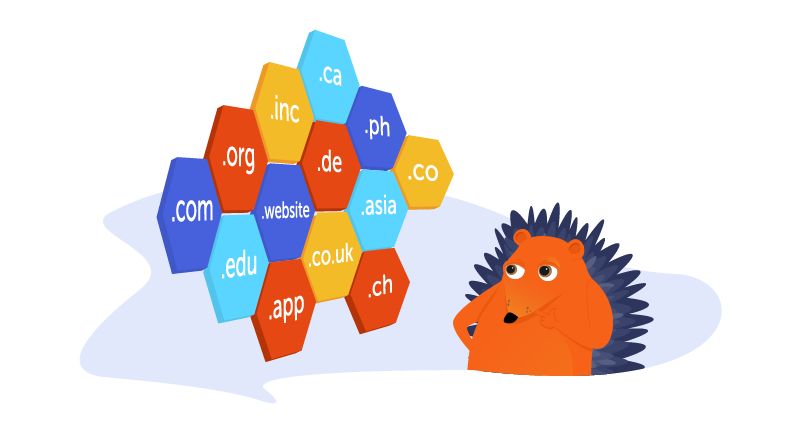
The TLD .com remains familiar, but it is far from the only credible option. Depending on the site, an extension such as .org, .co, .store, .design, or a relevant country-code domain may be a clear and memorable fit.
Consider how the extension will look and sound as part of the complete domain. Ask whether your audience will recognize it, whether it suits the site’s purpose, and whether it could be confused with a more familiar alternative.
Also check the rules. Some extensions have eligibility, location, documentation, or renewal requirements. Namecheap’s full TLD list lets you compare available extensions and review important details before committing.
Compare the renewal price, not just the first-year deal
A low introductory price can be appealing, but a domain is an ongoing expense. Check the registration, renewal, and transfer prices before buying. Some extensions renew for substantially more than their first-year promotional price, and premium domains may have different pricing from standard registrations.
You can compare current domain prices and read more about what affects the cost of a domain name.
While you are comparing registrars, look beyond price. Consider account security, domain privacy, renewal reminders, customer support, transfer controls, and DNS management. The cheapest first year is not much of a bargain if managing the domain becomes a recurring headache.
Register the domain in the right account
Your domain is a business asset, so the account and registrant information should belong to you or your organization. Do not let a web designer, employee, or agency register it under a personal account that you cannot access.
Use an email address you monitor for the account and registration contacts. Keep the information accurate, complete any required verification, and make sure more than one trusted person knows how the business can recover access if appropriate.
If someone else helps manage the domain, give them the access they need without giving away ownership. This is less exciting than brainstorming names, but it can prevent disputes, lockouts, and emergency detective work later.
Protect the domain from day one
Registration is not the finish line. Before you close the tab and celebrate, take a few minutes to protect the new domain:
- Use a unique, strong account password.
- Enable two-factor authentication.
- Turn on auto-renew and keep the payment method current.
- Confirm that domain privacy is enabled when the extension supports it.
- Keep the registrar lock enabled except when you are intentionally transferring the domain.
- Consider DNSSEC if it is supported by your domain and DNS setup. DNSSEC helps protect visitors from being redirected through forged DNS data.
- Save recovery codes and document who is responsible for renewals and account security.
Auto-renew is especially important, but it is not magic. Cards expire, and billing attempts can fail. Keep the renewal date on a business calendar and pay attention to registrar notices.
Cover the variations that matter
Registering every possible spelling and extension can get expensive quickly. Focus on variations that protect a real audience or a valuable brand.
That might include the most likely misspelling, a version without a commonly omitted word, or the extension people are most likely to type by habit. You can redirect those domains to your main website. Our guide to registering common typo domains can help you decide which variations are worth considering.
You do not need to collect domains like commemorative spoons. Buy the ones that solve a clear problem, then remember that each one has its own renewal date and cost.
Ready to register your domain?
The best domain names are not necessarily the cleverest. They are easy to remember, difficult to misunderstand, suited to the brand, and properly protected.
Once you have tested your options and checked for unwanted baggage, use Namecheap’s domain search to find an available name and review your choices. Take a final look at the spelling and contact details before submitting the order. It is a remarkably cheap proofreading step.
Frequently asked questions
How do I choose a good domain name?
Choose a domain that matches your brand, is easy to say and spell, and leaves room for the business to grow. Avoid unnecessary numbers, hyphens, alternate spellings, and anything that requires a long explanation.
Does a domain name affect SEO?
A clear, relevant domain can help people understand and remember a site, but keywords in the domain alone have little effect on Google rankings. Useful content, technical quality, authority, and the overall user experience matter much more.
Is .com always the best domain extension?
No. The .com domain is familiar, and often a strong choice, but another extension may fit your organization, industry, location, or audience better. Check its reputation, registration rules, and renewal price before deciding.
Should I register misspellings and other extensions?
Register variations when they protect meaningful traffic or reduce likely confusion. A common misspelling or obvious alternate extension may be worthwhile for an established brand, but most businesses do not need every possible variation.
What should I do immediately after registering a domain?
Verify the contact information, enable domain privacy when available, turn on auto-renew, use two-factor authentication, keep the registrar lock enabled, and record the renewal date somewhere your business will not overlook it.





tradmark247.com is trademark247.com FYI
Corrected, thank you.
Great guide to find the right domains, but my question is in order to rank on search engine shall i take brand name or exact match domain or partial match domain?
I suppose one could argue that having an exact match between your business name and your domain is ideal. However, search engine optimization is far more than what domain you choose. It’s about your content and other factors. Check out our recent article at https://www.namecheap.com/blog/dont-need-magician-optimize-seo/ for more tips.
Great guide to find the right domains