How to run a business from anywhere this summer
Cloud-based tools and portable devices have made it possible to do business from anywhere there is a signal.
Where you can work from successfully has exploded, and true digital nomadism no longer has to be an unattainable ideal. You really can run your digital enterprise from a beach with a piña colada in one hand and your iPhone in the other.
But that doesn’t mean it’ll work for every business, and for it to work for any business, you need the right tools and approaches.
Businesses best-suited to remote operation
I won’t be exhaustive here. Any tech-savvy entrepreneurial type who lived through the pandemic knows more or less what they can do from their phone or laptop. And it’s pretty much anything that doesn’t require physical movement of objects or in-person examinations.
While certain industries are better suited to remote work/business than others, more can support a semi-nomadic lifestyle by utilizing a hybrid model. Let’s take a closer look at how different kinds of nomadism might play out, and why they work.
Freelance digital nomads
If you’re a digital professional considering selling your services on a by-job or by-day format, there’s a good chance nomadism could work for you. Because anything made on a device (digitally) can be created more or less anywhere.
Our minds likely go straight for writing, design work, and media content creation, but the scope is actually much broader. Could professions like architects or product designers make things work remotely? Or what about music production and voiceover work? When you start thinking about it, the scope immediately broadens. But with some caveats. And this is where we first encounter the idea of semi-nomadic trades. Ones with a base, that can also be portable when required.
To make one of these more obscure professions work, some personal ingenuity comes into play. It’s time to plan:
- Your minimum equipment list: Let’s run with the example of a freelance music editor for a moment: You can’t carry an entire studio with you, but you can carry Logic Pro and some decent headphones. It’s essential to combine this minimalist approach with point two:
- Your schedule/tasks on, and leading up to, time away: By planning/scheduling travel tasks around your minimum equipment list, you can broaden your scope for travel. Not everything has to be done on the beach. If you have creative and administrative jobs, maybe you can do the creative side at home, and save up the admin jobs for the beach.
- Insurance for your gear: If you are traveling with technical kit, you’ll want to make sure you aren’t putting yourself at risk. Insurance is a good shout if you are taking expensive items away.
- Customs requirements: This is vital. It’s no use carrying something to find you have to abandon it at the airport. Check travel restrictions and pack so nothing causes a problem. Electronics are often considered high-risk items, especially if they contain lithium batteries. Check, check, and check again. Ring the airline if necessary.
Selling digital products
If you prefer not to work freelance, and want to build something that exists online, you might want to consider building a content platform website. It means working for little until you’ve built up enough to attract customers (and could therefore complement a freelance lifestyle), but whether your site sells learning courses, e-books, software, photos, or other media, these kinds of businesses lend themselves especially well to digital nomadism.
There’s also a big perk: The products you create can usually be sold (or licensed) infinitely. A good digital product catalog can, in some cases, offer continuous revenue, long after you put in the work.
Very few sales platforms (like WooCommerce) are tied to a geographic location. And while you’ll likely want to target those primarily in your own currency and language (for ease in both communication and marketing, and to avoid unnecessary conversion fees), you can certainly run your store from anywhere with a signal.
Also, the more of a portfolio you build up, the better your SEO is likely to get, and the more customers you will attract… It’s a positive cycle, and one that, if you get it right, can create passive income from anywhere in the world once the foundations are laid.
Professional services
It isn’t just creatives who can freelance remotely these days. Professionals across the board, from clinicians and counselors to accountants and consultants, can now deliver their services remotely using video calls and cloud-based software.
Therapy and life coaching are particularly popular when it comes to digital delivery (who hasn’t seen an ad for BetterHelp, for example), but almost any trained professional can do it. Whether you go fully digital with your clientele or adopt a hybrid model (see below), it’s definitely something that can be run from a spot in the sun, either permanently or for your summer holiday.
Hybrid businesses
Perhaps you already have a business that’s tied to a brick-and-mortar location, or maybe your idea would benefit from having one. Hybrid approaches can offer the best of both for those who want to travel.
E-commerce
E-commerce is a good example of something that can thrive using a hybrid model. To deliver the best prices, especially with resale businesses (stocking other people’s products), you’ll usually need to buy products in bulk and store them. But that needn’t be all you do.
There are companies that are happy to drop-ship items for you (that means send products as if from your business, often even including your company logo and receipt).
By building a catalog that’s a mixture of both, you have the advantage of securing the best prices. Then, when you want to head into the hills or down to the coast, you can just flip the warehouse products to out of stock and rely solely on the dropship items while you have your summer holiday.
Hybrid professionals
As I hinted above, for most professionals, location remains a surprisingly important part of how they operate. While folks jump to eBay, Amazon, and their favorite indie online stores first, it might be fair to say the transition to entirely digital meetings with, say, accountants, clinicians, and the like is still ongoing. If you already have a consultancy business, you’ll likely know this.
By being remote, you risk losing this ingrained norm, so having a base from which you develop in-person contacts/clients (on the understanding that you intend to run some sessions remotely) is a great happy medium. You get all the time away you want, and they get you in person for most of the time. You could even reach out to existing clients to see if they’d be happy with remote meetings.
Things any remote business needs
Whatever your business, there are helpful ways to make it more portable. We’ve already mentioned some, but let’s expand further so you can “pack it up” and take it on holiday with you without any worries.
Remote running
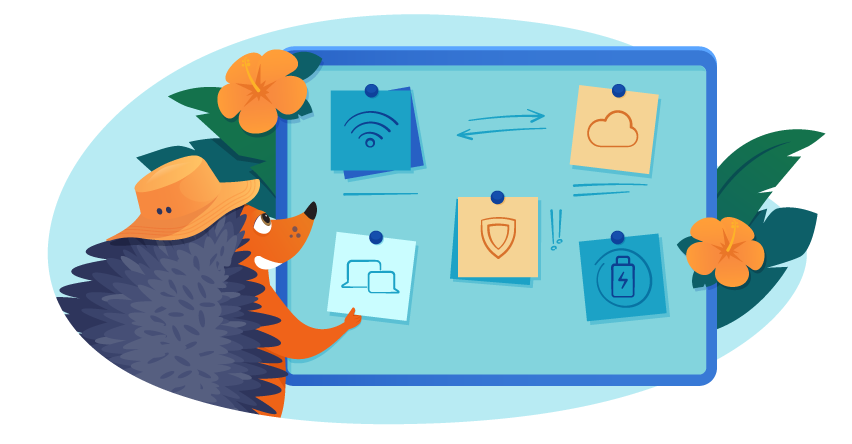
To run your business remotely, you’re going to need three things:
- Gear — the devices that you’ll use to work (as we’ve mentioned), but also reliable access the Internet.
- Access to all your internal systems — meaning passwords, permissions, and apps (including comms).
- A few added extras — for your own peace of mind.
Gear
We’re going to take both a laptop and phone. And yes, I do think both, because they serve slightly different functions. A phone is far more portable, and you’ll almost always have it on you (except while in the sea. That’s $600 I’ll never see again).
A laptop makes it far easier to complete tasks that are difficult or fiddly on a phone. So I personally think both are essential. But here are a few other things you may not have thought of.
Two-factor authentication devices
Consider carrying a hardware security key. Besides being one of the most secure forms of two-factor authentication (2FA), a physical security key can provide access to important systems when you’re on the move, even if your phone is lost, stolen, damaged, or out of battery.
Portable Wi-Fi (with backups)
Wi-Fi is fairly ubiquitous these days, but it certainly can’t be relied upon — especially when your business depends on a Zoom meeting, where a stable connection is a must.
Your phone can be a lifesaver here. Tethering gives you your own internet connection and is generally a safer option than relying on unknown public Wi-Fi, provided you have a strong mobile signal. If connectivity is critical, it’s worth having an entirely separate backup device or mobile hotspot, ideally using a different mobile network in case your usual provider has poor coverage or suffers an outage.
If you’re feeling particularly extra, you may want to consider Starlink. Its portable satellite Internet options can make working in very remote locations practical, and may be worth the price if you’re planning to be working very, very, remotely.
“Airtags” and power adapters
With so much riding on your devices, it’s worth considering Airtags (or one of their cheaper competitors). They can be relatively inexpensive and may offer peace of mind.
Make sure you have a backup battery and a universal power adapter as well. This is just good packing sense.
Accesses
Make sure you have remote access to all of the software you need. This will likely include your site servers and other systems that, day to day, you may rely on being in the office for.
Set up a robust password manager (like Bitwarden) to ensure that, if you ever come unstuck, you have a secure place to go to that doesn’t leave your passwords exposed on your device.
Communication apps
Access to your team or clients is about as important as it gets, so you want your plans for this to be robust.
It goes without saying you will need a way to communicate. Whether it’s clients, suppliers or staff members, you’ll want something like Zoom, Teams, or Google Meet. If you are doing consultations remotely, make sure you upgrade (or choose one without a limit) to avoid pesky timeouts cutting your call off mid-flow.
Also, be sure to place a contact form on your site. It is an invaluable, always-on way to generate new interest and manage inquiries, setting expectations when you’re out of range.
Added extras
These are things that might not seem essential, but you’ll be glad you have them on the road — and they set up good practices long-term.
Cloud storage
Whether you’re syncing files with a team or just backing up your work, it’s worth having something like Google Drive, OneDrive (or if you’re feeling more indie, MEGA) to keep your work safe. The reason I mention MEGA is you can currently get 20 GB for free, and there’s a useful desktop app you can download that syncs everything every time you save.
It’s also good practice to run a full site backup on a separate server, daily, in case something happens to your website.
Security
While there are other things you might want to have (like additional firewalls and anti-malware software), a VPN is non-negotiable. You will be working from Wi-Fi, and whether it’s a cafe or airport lounge, open Wi-Fi connections are notorious for interception.
What some people don’t realize is that needing a password to access a public Wi-Fi router doesn’t make it secure. Anyone on the network can potentially eavesdrop on your device if so inclined. A VPN gives you your own network within the network. A place you can be secure.
Day-to-day operations abroad
Being a digital nomad is about more than just having the kit and access. There are fundamental differences when it comes to working away from home that are easy to forget until you really think about it.
Time zones
Make sure you are available and willing to work when your customers are awake.
In my experience, almost every time zone has an overlap of business hours that’s surprisingly workable. As someone based in the UK, I find the late afternoon (around 4–6pm) ideal for speaking with people in North America, while mornings are generally better for countries ahead of the UK, such as China and the Middle East.
The only time zones without any business-hour overlap are those very far ahead, like Japan, Australia, and New Zealand.
Times without Internet
Flight? Trek up a mountain? Remote beach? Whatever it is, if it seems like coverage might be patchy, or non-existent, it’s worth ensuring you have some backup work.
Have that admin task you’ve been putting off at the ready, or maybe you could peruse your company accounts… Anything else you can do offline, or download to your device. Also, make sure you have some offline software (so you’re not relying on the online versions of Google Docs or Office) to work.
Plan Zoom calls in advance
Whether you’re checking in with staff or clients, it’s worth scheduling calls regularly and in advance to ensure you are available and have a reliable signal.
Know your legal footing
One thing worth a little mention: Working from abroad isn’t always as simple as opening your laptop wherever you land.
Depending on how long you’re away and where you’re going, you may need a digital nomad visa rather than relying on a standard tourist visa.
Many countries now offer these specifically for remote workers, but the rules (and how strictly they’re enforced) can vary a lot. It’s also worth a quick check on tax residency. Spend too long in one country, and you may find yourself liable to pay tax there, on top of at home.
None of this needs to stop a galloping horse. For a few weeks away, it’s rarely an issue. But if you’re planning to properly “nomad it” for months at a time, it’s worth ten minutes of research (or a chat with an accountant) before you commit.
Also, not all holidays need to be abroad! Working from a new location in the US solves visa issues, and states like Washington, Florida, and Texas have no income tax, which makes them particularly appealing to digital nomads.
A thousand-mile holiday starts with a single step
Running a business remotely is less about location and more about having the right systems at your disposal, and most vitally, a reliable connection to the Internet.
It’s worth remembering a business doesn’t have to be wholly remote (or portable) to be a success, and allow you the holidays/time away that you crave. Using one of the hybrid ideas we’ve discussed above might be a great way to strike a balance.
Start building your remote business today, and save up to 97% across the board in our Summer Sale. Get everything from the domain and hosting to the VPN you need for safe browsing.
See you on the beach!