Beyond backlinks: Building entity trust for AI search
For nearly two decades, the playbook for getting noticed online was straightforward. Build a website, get other sites to link to it, and repeat. If enough authoritative domains pointed to you, search engines assumed you mattered.
That playbook is breaking down.
We are moving into an era where search engines do not just find information — they summarize it. When someone asks ChatGPT to recommend a local accountant or Perplexity to find the best project management software, they get a single confident answer, not ten links to sort through themselves. The engine has already done the choosing.
And here is the part most businesses have not yet caught up with: the criteria for being chosen have nothing to do with backlinks.

From popularity to verification
Traditional search was a popularity contest. Modern answer engines run a verification contest.
When a tool like Perplexity or Google’s AI Overviews recommends a business to a user, it is putting its own credibility on the line. If it sends someone to a company that has closed, changed its name, or misrepresented its services, the tool looks unreliable. To protect against that, these systems have shifted from asking “who is talking about this business” to asking “who is vouching for it and how certain can we be that the information is accurate.”
This is what entity trust means in practice. It is the accumulated proof that your business is exactly who it says it is, does exactly what it claims to do, and is recognized by established third-party authorities. Getting this right comes down to three specific signals.
Signal one: N.A.P. vaulting
N.A.P. stands for name, address, and phone number. You have probably heard this before in the context of local SEO. What has changed is the consequence of getting it wrong.
When an answer engine encounters your business across multiple sources — your website, a directory listing, a social profile, a press mention — it is quietly running a consistency check. Every discrepancy, however small, lowers your business’s confidence score. A mismatched phone number here, a slightly different company name there, an old address that never got updated. Each one introduces noise into the machine’s picture of who you are.
N.A.P. vaulting means treating your core business facts as a single locked record that propagates identically everywhere. Not approximately the same. Identically. The goal is to give every system you encounter no reason to second-guess your legitimacy. When your facts are consistent across a 19-year-old directory, your own website, your Google Business Profile, and your social accounts, you are building what verification systems recognize as a trust chain — a sequence of corroborating sources that collectively confirm your identity without requiring a human to investigate.
Signal two: schema anchoring
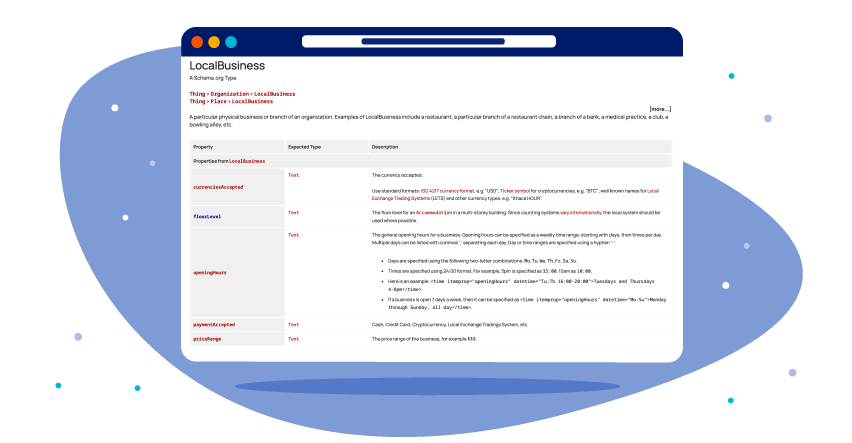
Structured data markup is not new. What is new is how central it has become to whether answer engines can cite you at all.
When your web pages carry properly implemented schema markup, you are essentially handing the engine a pre-filled form about your business. Instead of asking it to interpret your marketing copy and make inferences, you are telling it directly what type of business you are, what services you offer, where you operate, and what your credentials are. The engine does not have to guess. Guessing introduces uncertainty, and uncertain sources get skipped.
Schema anchoring takes this a step further. It means ensuring that the structured data on your site is corroborated by structured markup on third-party properties with long-standing domain authority. At DirJournal, every listing is assigned schema markup across more than 30 schema types depending on the business category. A law firm receives different structured treatment than a logistics company or a digital agency because they are fundamentally different entity types, and search systems need to clearly understand that distinction. When a business’s own schema aligns with the schema applied to its verified directory listing on a domain trusted since 2007, the corroboration creates an anchor that engines treat as reliable.
This is what helps businesses qualify for Google’s Knowledge Graph and appear in AI-generated summaries. Not the volume of their backlinks but the clarity and consistency of their structured identity across authoritative sources.
Signal three: freshness
Old data is a liability in verification-based search.
An engine that recommends businesses to users needs to ensure the information it surfaces is current. A verified listing from three years ago with no subsequent updates is almost worthless as a trust signal because it tells the engine nothing about whether the business still exists, still operates in the same way, or still serves the same market.
Freshness does not mean constantly rewriting your content. It means ensuring that human-verified timestamps are visible and up to date, that your core facts are audited and confirmed regularly, and that any changes to your business are reflected across your entire digital footprint promptly. At DirJournal, we apply human editorial review to listings rather than relying on automated processes because the verification timestamp only carries weight if a real person stands behind it. Machines can tell the difference between a system that auto-publishes data and one where a human has actually looked at the record and confirmed it.
What this looks like in practice
When we rebuilt DirJournal this year after nearly two decades on a legacy PHP system, we made a deliberate decision to stop thinking of it as a directory and to start thinking of it as an entity-verification hub. Every listing that goes live has been reviewed by a human editor, assigned category-specific schema markup, and tied to a verified timestamp. We also built a set of diagnostic tools that let businesses check their own standing — the Health Check at DirJournal shows how a listing performs across trust, expertise, and authority signals, and the AI Visibility Checker surfaces whether a business is being cited when people ask relevant questions in their category.
The shift we made internally mirrors what any business needs to do externally. Stop optimizing to be found by a crawl. Start optimizing to be verified by a system that is making recommendations on your behalf.
Practical steps you can take this week
Audit your N.A.P. consistency. Search your business name across every platform where you appear and flag any discrepancy in how your name, address, or phone number is listed. Fix the outliers before anything else.
Implement or audit your schema markup. If your core pages do not include structured data that clearly identifies your business type, services, and location, that is the gap to close first. Use Google’s Rich Results Test to see what the engine is actually reading.
Get listed on established authority sites. A verified profile on a long-standing directory with genuine domain authority acts as a third-party anchor for your business identity. When that profile carries structured markup and a human-verified timestamp, it contributes to the trust chain that answer engines use to decide who gets cited.
Update and confirm your data regularly. Set a quarterly reminder to check that your business facts are current and consistent everywhere they appear. Freshness signals are easy to maintain once the foundation is right.
What comes next
The businesses that will be cited by answer engines over the next few years are not necessarily the ones with the most backlinks or the highest domain authority scores by traditional measures. They will be the ones that have made it easiest for machines to verify them with total certainty.
The shift from ranking to verification is not a trend to watch. It is already the operating reality for anyone whose customers are starting their searches in ChatGPT, Perplexity, or Google’s AI Overviews. The question is not whether this affects your business. It is whether your business is ready to be vouched for.
Frequently asked questions
Why are my rankings dropping even though my backlinks are strong?
In many cases, the issue is not your ranking position — it is the zero-click trend. Answer engines resolve queries directly on the page without sending users to a website. If your business is not recognized as a verified, citable entity, the engine may be surfacing a competitor whose structured data is cleaner and more consistent, regardless of your backlink profile.
How does a directory listing help with modern search visibility?
A directory with long-standing domain authority functions as a third-party notary for your business facts. When a 19-year-old domain with verified editorial standards vouches for your data, it contributes meaningfully to the trust chain that answer engines use to confirm your legitimacy. The key is that the directory uses structured markup and human verification rather than automatically accepting submissions.
What is the single most important thing to fix right now?
Consistency. Ensure your business name, address, and core service description are identical across your website, your social profiles, and every directory where you appear. Eliminating data noise gives machines a clear, unambiguous picture of your identity — and that clarity is the foundation upon which everything else is built.