AI model collapse: when AI starts training on its own echoes
Something quietly strange is happening in the world of AI. The models we’re building are getting smarter, sure, but they’re also eating more and more of their own output. Think about it: the Internet is drowning in AI-generated text, images, and code.
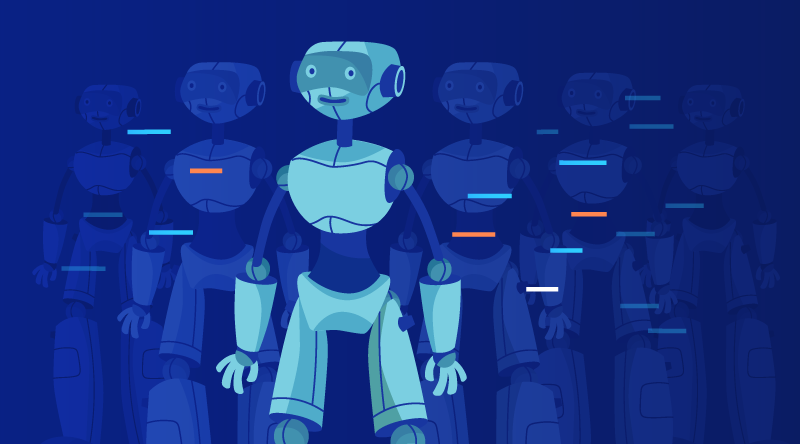
And that same content is being scraped to train the next wave of models. It’s a loop with no exit, and researchers have a name for what happens when you keep feeding a model its own reflections: model collapse. It sounds dramatic because it is.
What actually is AI model collapse?
Model collapse occurs when an AI model is trained on data that was itself generated by AI. By now, we’ve already lost the plot and come to terms with the fact that it’s often impossible to spot non-human content.
Over time, AI models lose touch with the diversity of the real world and converge on a narrower, blander version of reality. The technical explanation involves probability distributions drifting away from the original data, but the intuitive one is simpler: the model starts forgetting things. What makes it tricky is that the drift doesn’t show up immediately. Early generations of a model might look perfectly fine. The degradation is slow and subtle, creeping in over multiple training cycles until human creativity is merely an echo, confidently wrong, or just weirdly flat.
Imagine going to a physical exam, then handing the results to another doctor, who then hands them to another doctor, and so on. Can the doctor at the bottom of the totem pole correctly assess you? Of course not. Model collapse works the same way.
Each generation of AI trained on synthetic data unknowingly inherits the biases and gaps of its predecessor, and without sufficient review, those errors compound rather than cancel out.
How did we get here?
It happened gradually, then all at once. For years, AI models were trained on human-written text: books, articles, forums, and websites. The data was messy, contradictory, and gloriously diverse. That diversity was actually a feature. It’s what gave models range.
Then generative AI took off. Suddenly, AI-written content started flooding the web at scale: blog posts, product descriptions, social media replies, and even academic abstracts. And since web scraping is still the dominant method for building training datasets, that synthetic content started getting swept up alongside everything else.
Researchers at the University of Oxford and elsewhere demonstrated this clearly in 2023. When models were trained on AI-generated text, output quality degraded across generations. Rare concepts and edge cases started disappearing. The model’s sense of what’s possible in language gradually shrank.
Why it matters beyond research papers
It’s easy to read about model collapse as a theoretical concern for researchers. It has real implications for anyone who uses AI tools, builds with them, or depends on the information they produce.
If the next generation of language models is trained on today’s wave of AI-generated content, they’ll be less accurate, less diverse in their reasoning, and the web as a whole will be more centralized. The tools businesses rely on for writing, coding, customer service, and research will quietly get worse without any obvious warning signs.
There’s also a cultural dimension here. Language models are, in part, a reflection of human knowledge and expression. If they start drifting toward an ever more homogenized version of what AI thinks humans sound like, something real gets lost. Not just accuracy, but texture, nuance, and the kind of edge-case thinking that leads to creative breakthroughs.

What’s being done about AI model collapse?
The research community is already on this. One of the most promising approaches is watermarking AI-generated content so it can be filtered out of training datasets. It sounds simple, but it’s genuinely hard to do at scale, especially when the whole point of a lot of generated content is that it’s indistinguishable from human writing.
Another approach is synthetic data curation rather than synthetic data avoidance. Some researchers argue that carefully controlled synthetic data can improve model quality, provided it’s used intentionally rather than scraped indiscriminately. The key is to maintain a strong anchor in verified human-generated data throughout the training process.
There’s also growing interest in provenance tracking for training data, essentially keeping records of where data came from and flagging content that’s already downstream of a generative model. It’s harder than it sounds, but it’s the kind of infrastructure the industry will need to build anyway.
What you can actually do
If you’re a developer, content creator using AI to create images, or someone building products on top of AI tools, model collapse is worth taking seriously now rather than later. Leaning heavily on AI-generated content without human review isn’t just a quality risk today; it’s also a contribution to the problem for whoever builds the next generation of models.
Maintaining genuine human editorial oversight in your content pipeline matters. So does being thoughtful about what you’re feeding back into any fine-tuning or training you do on your own models. Garbage in doesn’t just mean garbage out in the immediate sense. It means compounding garbage across every future iteration.
The broader point is that AI quality depends on the quality of what humans put into it. That relationship hasn’t changed, even if the scale and speed of AI-generated content have made it easier to forget.
Should we worry about AI model collapse?
Model collapse isn’t a doomsday scenario. It’s a feedback problem, and feedback problems can be managed when you understand them.
The issue is that the Internet moves fast, training datasets are enormous, and the incentives to ship AI products quickly don’t always align with the patience needed to curate data carefully.
Awareness is growing at exactly the right time, though. Researchers are publishing, companies are paying attention, and the conversation about synthetic data contamination is going mainstream. The echo chamber only closes in if nobody pushes back.